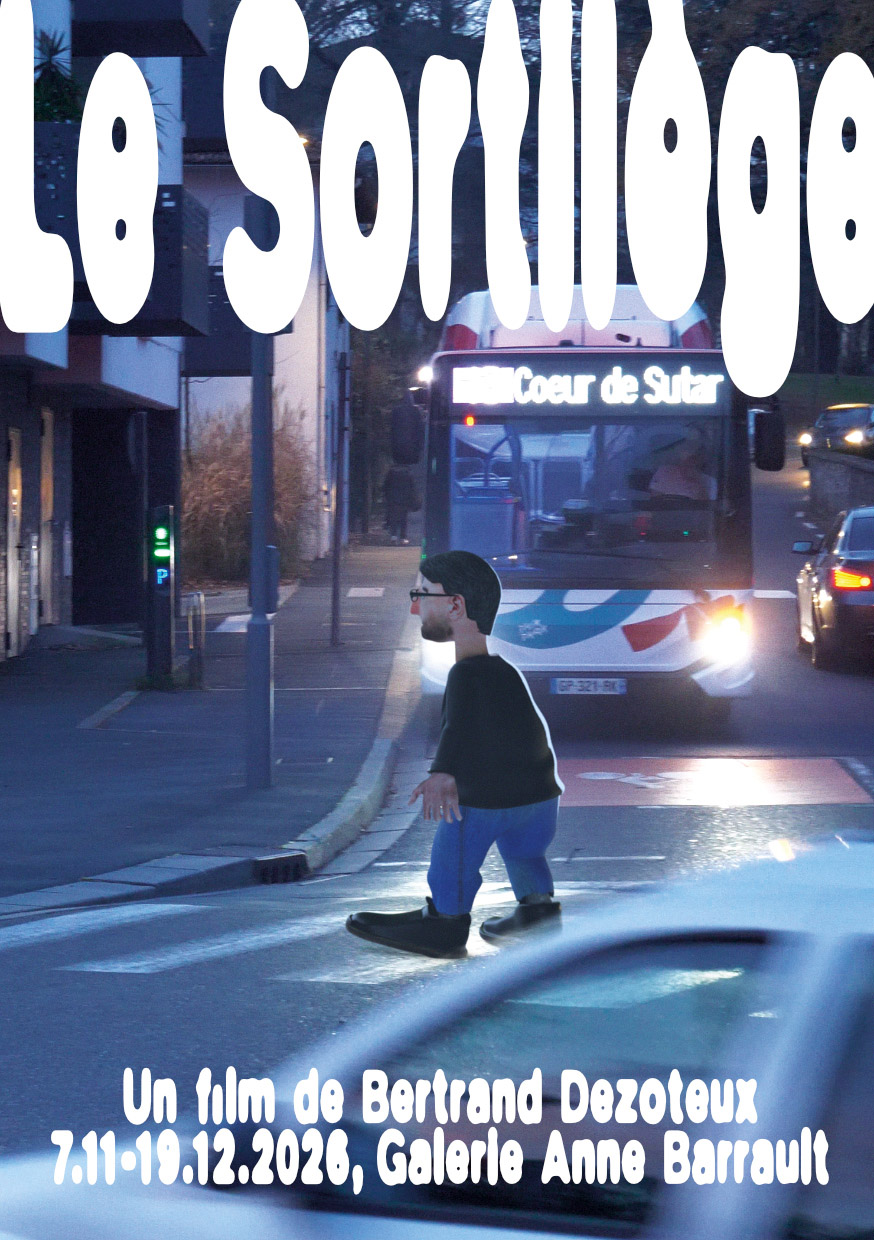
For his first solo exhibition at the gallery, Bertrand Dezoteux presents a collection of watercolors and a new film titled Le Sortilège. Blending animation and live-action footage, the film recounts a defining moment in the life of Rémi Pitoys. He is a driving instructor and seems to have been bewitched.
_________________
Checking blind spots, sorting out the pieces of information we receive, estimating the distance of a car in the rearview mirror while convincing ourselves that road conditions ahead won’t change drastically while we check for traffic on the sides or behind us: getting a driver’s license can be like attending a school of perception. It also means entering a system of signs and a language that each instructor conveys in their own way, and from which we may eventually retain certain sentences that vary between instruction and mantra. An instructor’s language exerts a form of influence that teaches you to perceive the road, to blend into its temporality and rhythms, to gauge distances, and to situate yourself within this reality mediated by the windows and the speed of the car in order to establish a driving style. To recreate this experience which forms the background of Le Sortilège, Bertrand Dezoteux guides us through a blend of live-action shooting, road signs generated by an automated model, and a computer-generated driving instructor character. Operating within a digitized conception of the world, this instructor is the only character in the film to appear as a computer-generated image.
Throughout the film, road signs, driving advice and traffic laws confront you with another way of being related to reality: a magic spell. These spells are the ones that one day strike the driving instructor, upending his perceptions and his place in the world. In witchcraft, the laws of causality falter, and speech becomes a total war in which one is bewitched or not, a sorcerer, or a spell breaker. The overflow beyond causality produced by witchcraft is expressed through the friction between real-world footage and computer-generated imagery, as well as between handcrafted models and those created by AI.
Whether it involves learning to interpret road signs in to yield the right of way or being subjected to a spell that causes one to lose sight and speech, in both cases one encodes and constructs a message according to the rules of a system of expression. By declaring oneself bewitched and seeking the help of a healer, one explains the series of misfortunes through a system of speech acts and forces just as precise as that of the traffic code.
Witchcraft is also a matter of territory: the territory occupied by the bewitched, and the territory his rivals seek to occupy. Bertrand Dezoteux reshapes this suburban area of Bayonne—travelled by the driving instructor along departmental and national roads, shopping centers and an industrial park. In “Le Sortilège”, the plasticity of the hand-modeled images and those generated by AI does not explore unknown worlds or fantastical creatures, but rather an everyday, hackney setting: the fifteen kilometers driven through by a driving instructor.
Bertrand Dezoteux resort to another form of language and another system of instruction: that of automated image-generation models that are controlled via prompts. Just as spells interpret events without relying on causality, automated models do not link causes to effects either. On the contrary, they identify reciprocal relationships—correlations between elements.
With Le Sortilège, the question is no longer whether we are in reality or a simulation, but rather how we constantly navigate between different mediations, models, and systems. Here, the rigid system of road signs is distorted by AI, which produces a version that is both generic and improbable—where shapes are slightly distorted, arrows no longer point in the usual direction, and no longer convey any recognizable instructions.
As for the spells cast on this instructor which remain off-screen, they may also evoke all the language necessary for AI to function—from annotations on training data to prompts—which, too, remains hidden from us. The various visual languages that Bertrand Dezoteux employs in Le Sortilège including live-action footage, dialogue, computer-generated imagery, and AI-generated content—invite us to navigate between the models that mediate our relationship with reality, sometimes enhancing it and sometimes diminishing it. In this story about learning to drive, the artist also uses different visual registers to reinterpret the relationship between documentary and fantasy fiction, shifting the Gothic novel of confinement to the suburbs and the rules of traffic regulations.
Elsa Boyer
The film Le Sortilège received support from the DRAC Nouvelle-Aquitaine and the Adagp