EVA AEPPLI – DOROTHY IANNONE – LA RIBOT – ROLAND TOPOR – ROBERT FILLIOU – LADJI DIABY – STÉPHANIE SAADÉ – BARBARA RÄDERSCHEIDT – JULIE DOUCET – FATMA CHEFFI – LIV SCHULMAN – CÉCILE PARIS – SARAH BENSLIMANE – PAVEL SCHMIDT
An exhibition that attempts to cover all aspects of Daniel Spoerri’s life. Nothing scientific, but rather instinctive, or perhaps simply an excuse to invite artists.
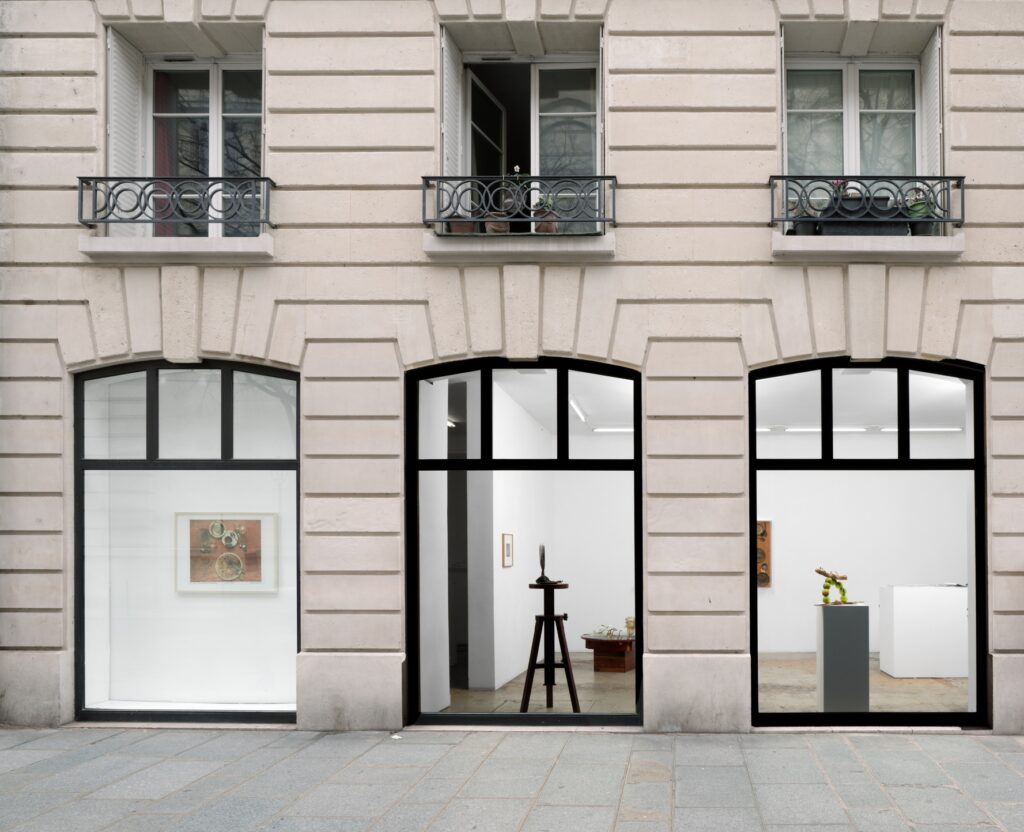
photo Aurélien Mole
First, the title, a quote from Daniel Spoerri, friendship as a foundation, a base. This is how we met Daniel, thanks to Alexandre Devaux, who had presented an exhibition featuring his works, along with those of Morellet and Topor. This exhibition took place in 2016, in a place that Daniel Spoerri had opened in 2009 in Hadersdorf, near Vienna, Austria.
It is because his friend Roland Topor introduced us to Daniel Spoerri that one of his drawings entitled “Channel N°5” is featured in this exhibition. A man, whose face is wrapped with a string, like a veal roulade, forces him to have his nose in excrement.
In Spoerri’s work, food, digestion, intestines, offal, and excrement are elements that can be found in his cookbooks, to which he invites his friends to contribute, as well as in his film “Resurrection” (1969, directed by Tony Morgan).
From the outset, the fundamental acts of eating and drinking formed the basis of “trap paintings”, which were very often tables where people had eaten. If the results were art, why shouldn’t the very act of eating be an artistic action? Eating is a form of investigation of the world and of oneself, the most social and one of the most intimate forms of communication, the most primitive celebration, along with dancing. (1)
These various meals took place during his exhibitions or in his restaurant in Düsseldorf, which was open from 1968 to 1982.
Four years ago, Cécile Paris created the Pan Café on Île St Denis. Artists rub shoulders with neighbors and students there. Everyone comes to drink coffee, listen, and share. Cécile is an artist, a café owner, and a teacher. Daniel Spoerri also taught for 12 years.
The story begins in 1977, when he received a phone call from Karl Marx. Marx was the director of the Cologne Academy of Fine Arts, offering him the position of professor of “Multimedia.”
Here, Cécile will exhibit part of her glass collection and, in March, will organize a meal at the Pan café conceived as a performance entitled “Renverser le plateau” (Overturning the Tray).
(1) Excerpt from Jean-Paul Ameline’s text published in the Daniel Spoerri catalog, 1990.
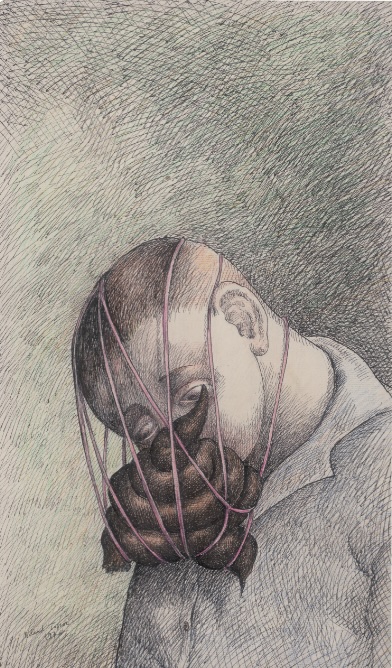
Roland Topor
Chanel n°5, 1976
encre noire et crayon de couleur sur vélin
47 x 27,5 cm
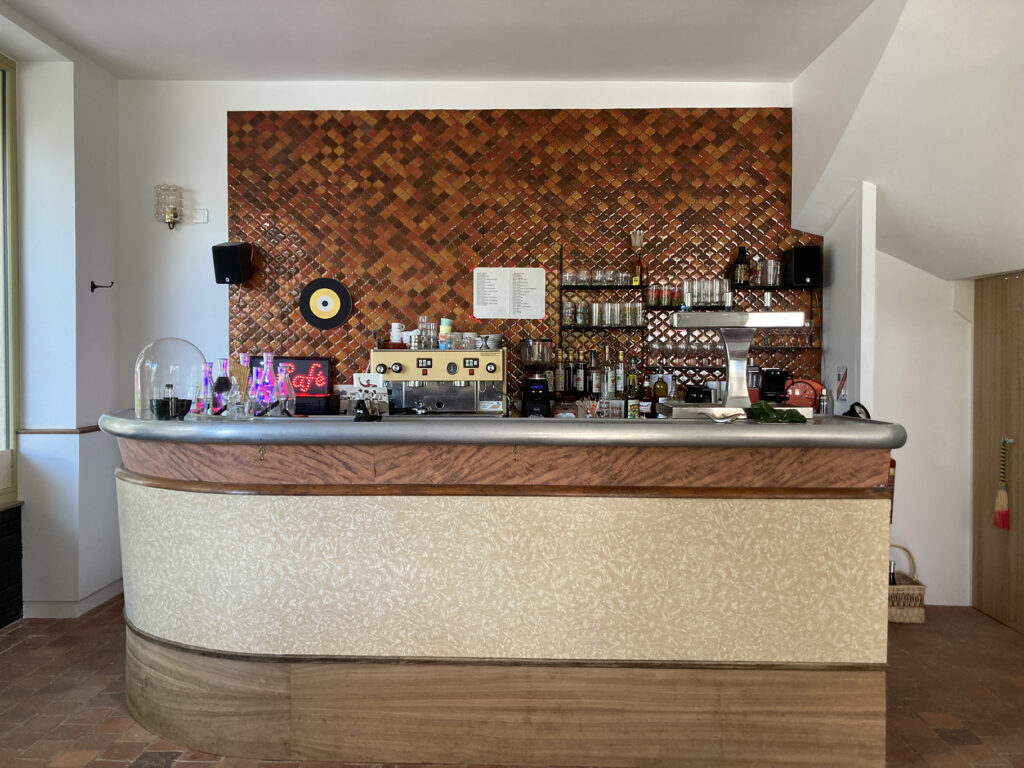
Cécile Paris, le Pan café sur l’île de St Denis
______________
Fatma Cheffi will present a necklace inspired by prehistoric jewelry and West African symbols. The symbol, also known as a “signal,” was a shameful object that was hung around the necks of students caught speaking a language other than French in colonial schools. A student caught in the act of linguistic transgression could only get rid of it by denouncing a classmate who had also spoken their mother tongue.
This work forges a link with Daniel Spoerri, who always explained that as a child he did not speak the right language and did not have the right religion. He studied at a German school from which he was expelled because of his father’s Jewish origins, then at a Romanian school which he had to leave for the same reason.
“Having a Jewish name while being not Jewish but Lutheran, in a region that was otherwise Orthodox Catholic. Having a Jewish father who no longer wanted to be Jewish but was killed as a Jew. Growing up in Romania speaking German and being raised by a Romanian mother of Swiss origin.” (2)
(2) Excerpt from Jean-Paul Ameline’s text published in the Daniel Spoerri catalog, 1990
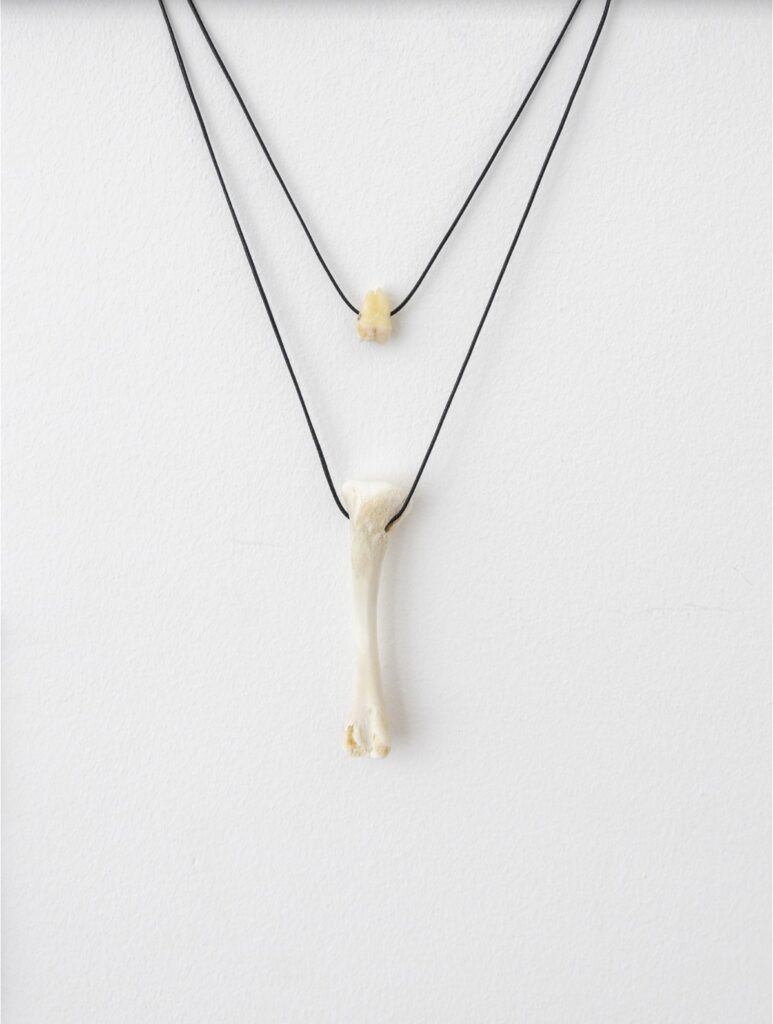
Fatma Cheffi
Symbol, 2024
Chicken bone, artist’s wisdom tooth
______________
This exhibition will also be an opportunity to see “The Story of Bern”, a book by Dorothy Iannone in which she recounts the censorship she suffered during the “Friends exhibition” held at the Kunsthalle Bern under the direction of Harald Szeemann in the spring of 1969.
Dieter Roth, Daniel Spoerri, André Thomkins, and Karl Gerstner, four old friends, had decided to invite a friend to participate. But Dorothy Iannone’s work was removed on the morning of the opening, and in protest, Dieter Roth withdrew his entire contribution to the exhibition the following day.
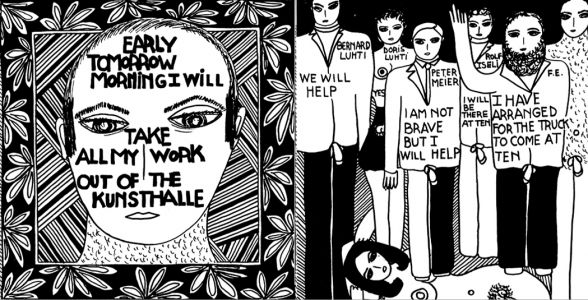

Dorothy Iannone
The Story of Bern, 1970
courtesy Air de Paris
_____________________
“Filliou is my big brother, but I am his mother,” Daniel Spoerri often said.
The three of them—Filliou, Topor, and Spoerri—created a set of 22 postcards entitled “Monsters are Inoffensive” (Fluxus edition, 1967), which will punctuate the exhibition of the works.

__________________
Daniel Spoerri began his career as a dancer at the Bern Theater. He was principal dancer from 1954 to 1957, before devoting himself to theater and poetry.
It was the perfect excuse to invite the famous dancer and choreographer La Ribot to present her video “Another pa amp tomàquet”, in which she re-enacts the shower scene from “Psycho”. But here Hitchcock is dethroned; it is Janet Leight who directs and cuts.
Here is one of La Ribot’s instructions for the performance: “Be generous—this is Catalan cuisine, not diet food!”
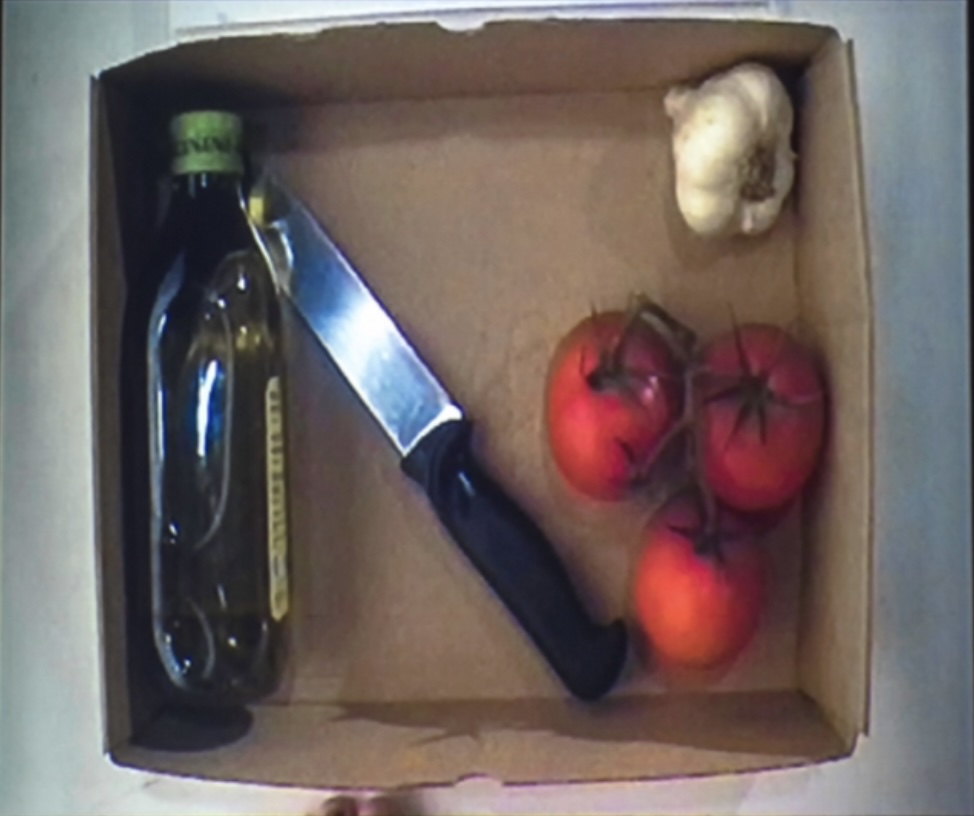
La Ribot
Another pa amp tomàquet, 2002
video, 12’
ed.12/25
courtesy La Ribot
____________________
Ladji Diaby is the youngest artist in this exhibition. He was born in 2000 and has just graduated from the Beaux-Arts in Paris.
He composes his works using found objects, which he then assembles. His work explores how to construct one’s own symbolic space in the face of narratives that come to him.
Here he will present a work entitled “The Wonder of You,” a coffee table on which various objects will be placed, some of them are difficult to identify. Unlike Daniel Spoerri’s “trap paintings” or “détrompe-l’oeil” works, which are always hung on the wall, Ladji Diaby will present his work on the floor.
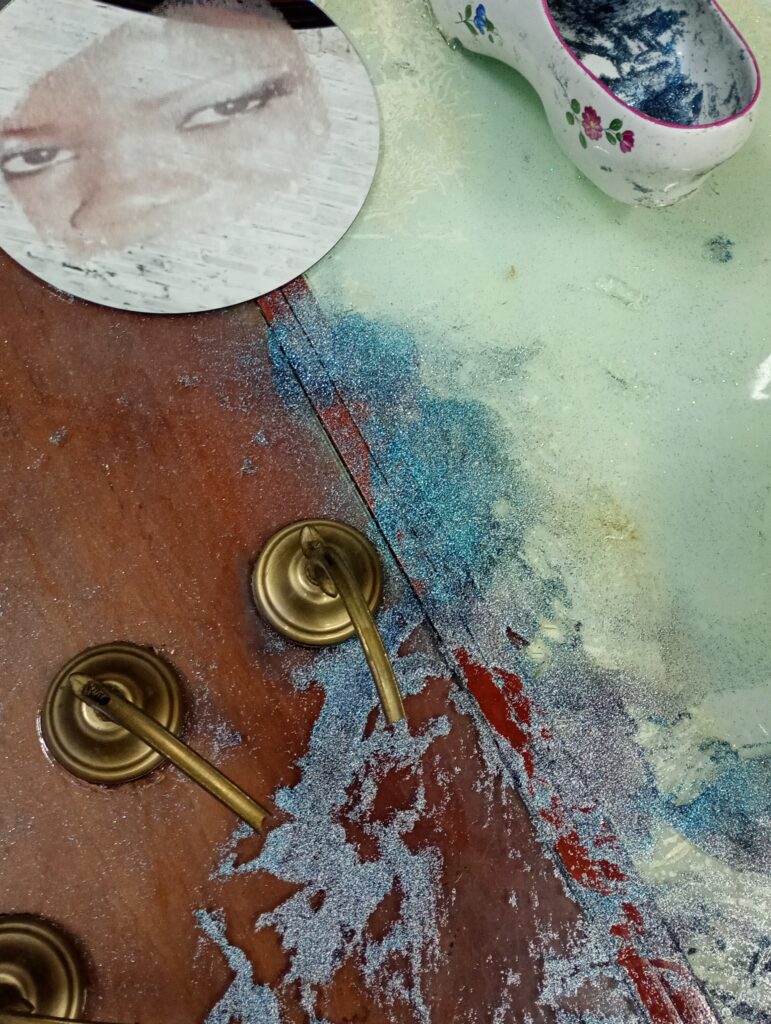
Ladji Diaby
The Wonder of You, 2025 (detail)
mix media
96,4 cm diameter
__________________
During an interview conducted by Deborah Laks in 2012, she asked Daniel Spoerri about the presence of death in his work. (An idea that had been put forward by Alain Jouffroy during his first exhibition, but completely refuted by Daniel himself). He replied: “Today I would agree with Jouffroy, fifty years later, I would say he was right. But at the time, I was furiously against it. I placed the “Tableaux-Pièges” in the history of the movement, later I placed them in the history of “détrompe-l’oeil”, and even later on the literary side, where one can deduce a story, a historical and narrative aspect.”
Liv Schulman assembled this ashtray sculpture from ham, a tennis ball, and a baguette while making one of her films entitled “Brown, Yellow White and Dead.”
According to the artist: “This piece was made from leftovers and surplus items that attempt to organize themselves as a kind of trophy or triumphal arch of minor or ignoble things.”

Liv Schulman
sans titre, 2023
tennis balls, wood, chopsticks, cigarettes, ham, resin
71 x 32 x 25 cm
__________________
When reading biographies about Daniel Spoerri, one name often comes up: Jean Tinguely. They met in 1950, first in Basel and then in Paris. This meeting was made possible by Eva Aeppli, whom he knew first. The two remained close throughout their lives.
Six sculptures by Eva Aeppli are on display in Il Giardino, in Tuscany. This 16-hectare garden, opened by Daniel Spoerri in 1997, houses around a hundred works by fifty artists.
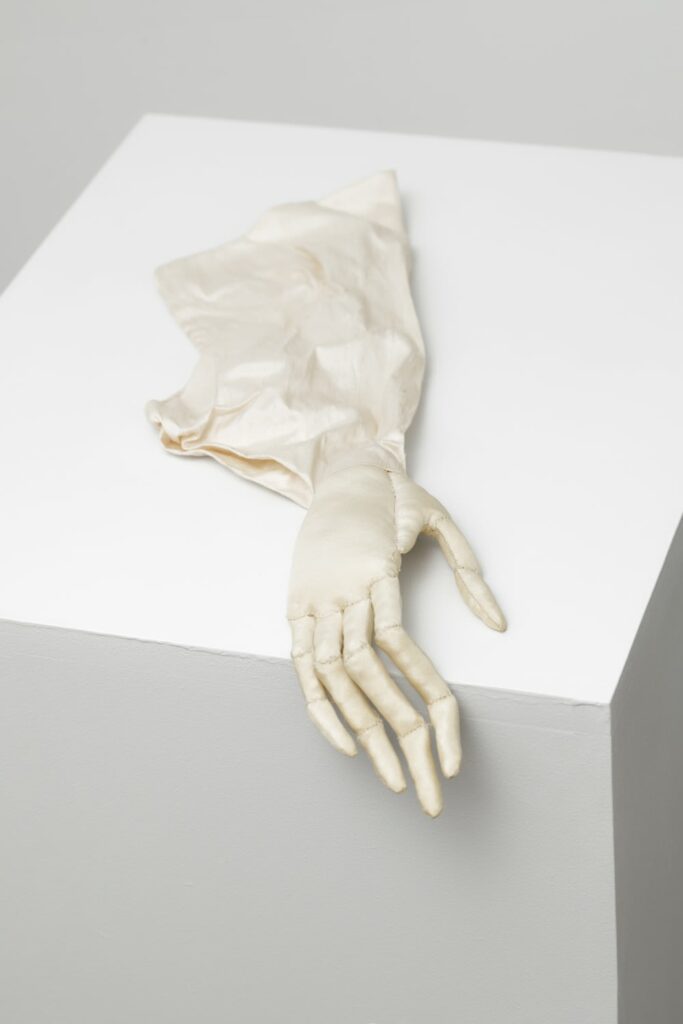
Eva Aeppli
sans titre
silk, cotton and kapok
2 x 48 x 15 cm
courtesy (sans titre)
__________________
Barbara Räderscheidt met Daniel Spoerri in 1978, when he was teaching at the Cologne Academy of Art and Design.
In 1997, they began working closely together, with Barbara accompanying Spoerri on most of his projects: she was president of the Il Giardino di Daniel Spoerri Foundation, and since 2010, she has been director of the Ausstellungshaus Spoerri museum in Hadersdorf am Kamp, near Vienna, Austria. At the same time, she continues her work as an artist.
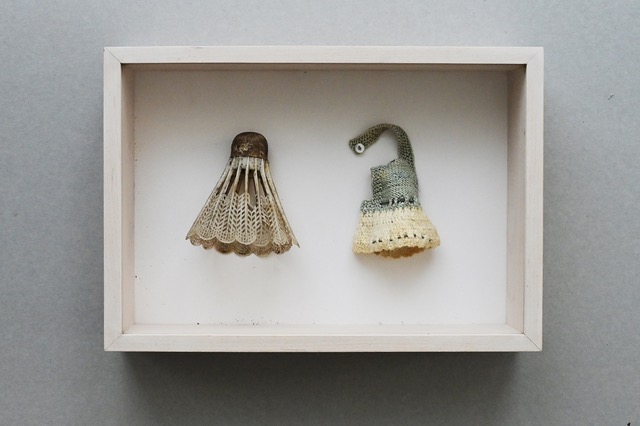
Barbara Räderscheidt
„Analogies“/ „Equations“
wheel and doll dress
19 x 27 x 6 cm
_________________
In 1957, Material, a concrete poetry magazine, appeared, edited by Daniel Spoerri in collaboration with Claus Bremer. An excerpt from the magazine’s program is announced as follows: “The author of these texts seeks to avoid conveying his state of mind to the reader, as he knows that his mood has only a relative connection, that is, in perspective with the reader.”
This magazine was his first collective project, to which Daniel Spoerri invited poets and artists. This was followed by MAT: Multiplication d’Art Transformable. The invited artists entrusted him with a model that enabled him to produce multiples, which were then all sold at a single price.
This was an opportunity to invite Julie Doucet, a famous comic book author who has created collages that become poems for the past twenty years.
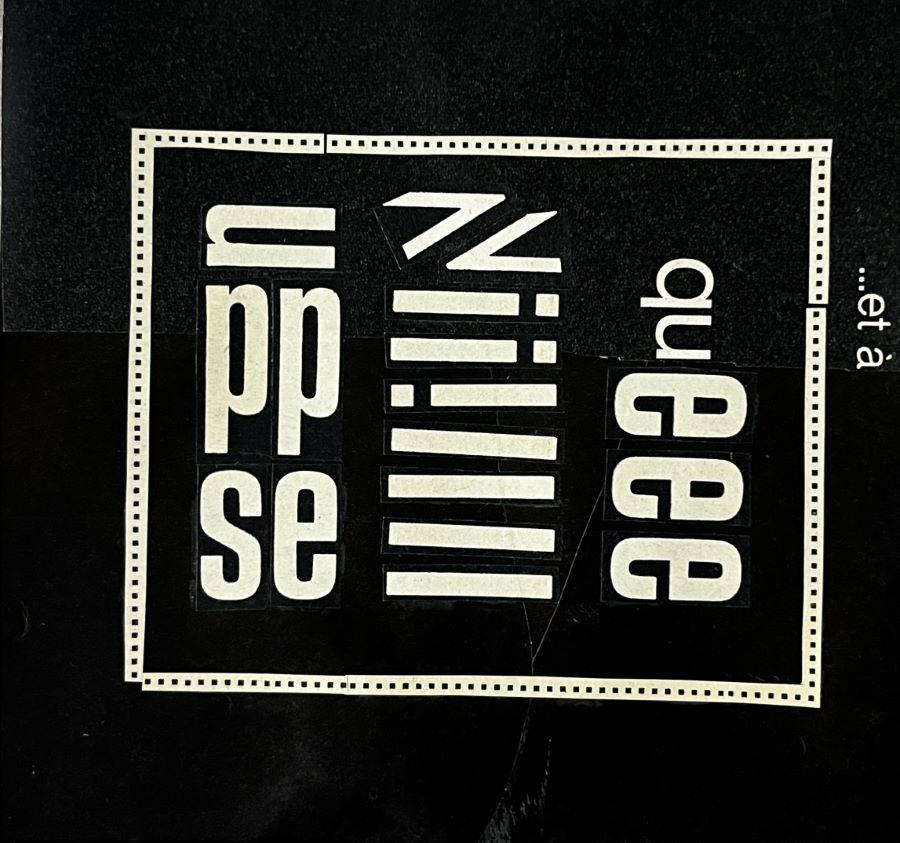
Julie Doucet
Sans titre, 2024
collage
17,5 cm x 15,5 cm
_________________
On the day of Daniel Spoerri’s death, Stéphanie Saadé created a calligram in which she traced his first name on a sheet of cardboard, then reproduced it on a sheet of tracing paper. The latter was then turned over and placed on the back, so that the two sheets overlapped. This arrangement suggests a gesture of reversal, which could be likened to “Déjeuner sous l’herbe”. The repetition and superimposition of Daniel’s first name (“standing” and “lying down”) then create a new shape.
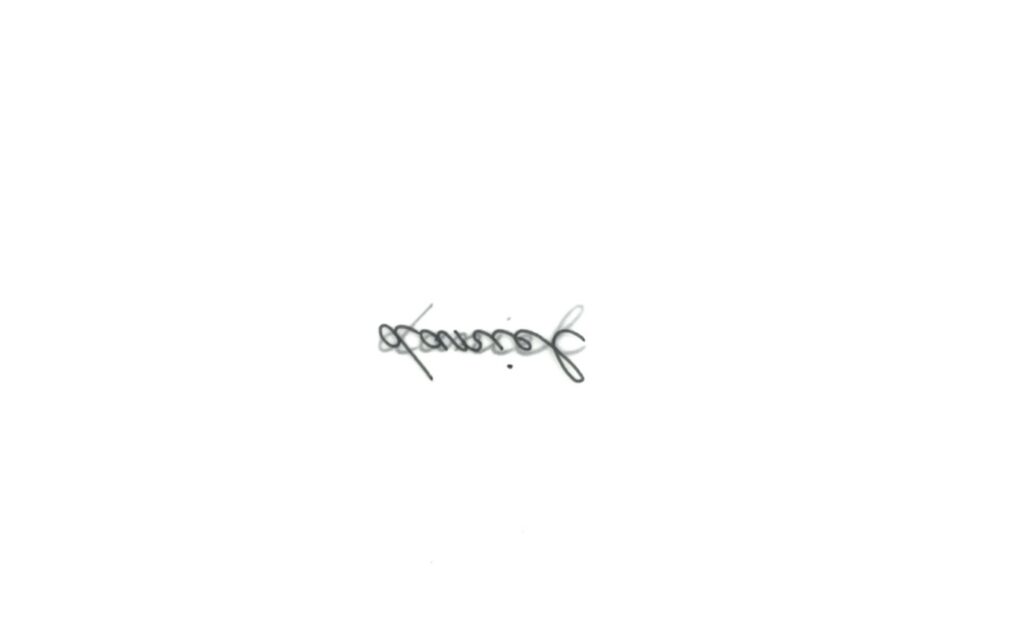
Stéphanie Saadé
Daniel, 2025
permanent ink on paper and tracing paper
31, 7 x 44 cm
_________________
This work by Sarah Benslimane combines various mirrors that she found or purchased. This young artist from French, Swiss, and Algerian origin questions the status of the work and has fun doing so.
“La panthère des neiges” reminds us of the many collections that Daniel Spoerri has assembled throughout his life: canes, glasses, kitchen utensils… but also the use of mirrors in his works entitled “les multiplicateurs d’art” (art multipliers).
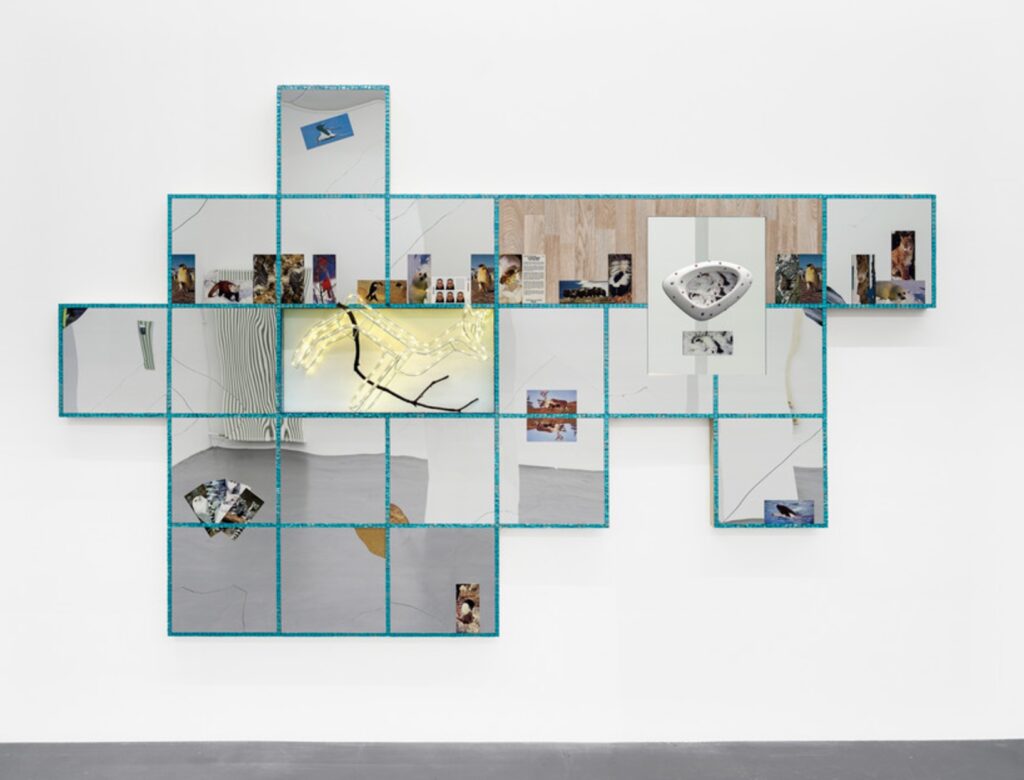
Sarah Benslimane
La panthère des neiges, 2025
media mixte
210 x 334 x 7 cm
courtesy galeria Madragoa & galerie Francesca Pia
______________________
Artists’ biographies
DANIEL SPOERRI
Daniel Spoerri was born in 1930 in Galati, Romania, and died in 2024 in Vienna, Austria. He lost his father during the Iasi pogrom in 1941 and fled to Switzerland with his family in 1942. He began his career as a dancer in 1954 and became principal dancer at the Bern Opera House, before working as assistant director at the Landestheater in Darmstadt, where he created the avant-garde revue “MATERIAL.” In the late 1950s, he produced his first snapshots, which he later theorized in Une Topographie anecdotée du Hasard (A Topography of Chance). Settling in Paris in 1960, he founded the MAT publishing house and published multiples by artists such as Duchamp, Soto, Tinguely, Vasarely, and Agam. Close to Yves Klein and Jean Tinguely, he signed the New Realism declaration. A friend of Robert Filliou, he also became close to George Brecht and George Maciunas, major figures in Fluxus. Spoerri then transformed the Galerie J. into a restaurant and elevated dining tables to the status of works of art. He opened a restaurant and the Eat-Art Gallery in Düsseldorf, where he exhibited works by Joseph Beuys, Niki de Saint Phalle, Morellet, and Topor, among others. In his more recent work, he exploits the evocative power of found objects: animal skulls, prostheses, tools, and utensils become elements of an invented primitive art, playing with beliefs and artistic codes. It was with this in mind that he created “Les Corps en morceaux” (Bodies in Pieces) at the Château d’Oiron in 1993. In 1997, he founded a sculpture park in Tuscany, which has become a major venue for his work.
LIV SCHULMAN
Liv Schulman was born in Argentina in 1985. She lives and works between Buenos Aires and Paris.
After studying at the École nationale supérieure d’arts de Cergy, she trained at Goldsmiths University of London in the United Kingdom and completed a postgraduate degree at the Beaux-Arts de Lyon. Her work has been shown at the Centre Pompidou, CRAC Alsace, Fondation Ricard, Biennale de Rennes, Galerie, Centre d’art contemporain in Noisy-le-Sec, and internationally at the Bemis Center For Contemporary Arts in the United States, SixtyEight Art Institute in Copenhagen, Museo Reina Sofía in Madrid, and Secession in Vienna, among others. Liv Schulman’s work includes documentary fiction, television series, performative readings, and fictional texts, all characterized by an in-depth use of language. These different forms of discourse serve as tools for interpreting the social world, exploring the complex role of subjectivity in the political sphere.
EVA AEPPLI
Eva Aeppli was born in 1925 in Zofingen, Switzerland, and died in 2015 in Honfleur, France. She grew up in Basel, where she attended the Rudolf Steiner School, which follows anthroposophical teaching methods. The Second World War had a profound effect on her, influenced by her father’s concern about the Nazi advance. She studied at the School of Arts and Crafts in Basel between 1943 and 1945. In the early 1950s, she met Jean Tinguely and Daniel Spoerri, moved to Paris, and became Tinguely’s first wife, while remaining close to Niki de Saint Phalle. Although surrounded by the New Realists, she forged a unique artistic language. Settling in Impasse Ronsin, next door to Brâncuși’s studio, she first created charcoal drawings and knitted images. In the 1960s, she painted large canvases inspired by the danse macabre. In the 1970s, she turned to astrology and created fabric heads, which she had cast in bronze in the 1990s. Withdrawing from the world at the end of her life, she devoted herself to her inner universe. Her works can now be found in numerous museums and private collections. In 2022, the Centre Pompidou-Metz will dedicate its first monographic exhibition to her in France.
ROLAND TOPOR
Roland Topor, born in 1938 and died in 1997 in Paris, was a multi-talented French artist: cartoonist, writer, illustrator, screenwriter, and actor. Published in the French and international press, he illustrated more than a hundred authors, created sets and costumes for theater and opera, wrote novels, short stories, and screenplays, and directed animated films, including La Planète sauvage. Co-founder of the Panic movement, he was associated with Cobra, the Situationist International, and Fluxus. His works feature in numerous major collections, and several posthumous exhibitions have been dedicated to him, notably at the Maison Européenne de la Photographie (1999), the Musée d’Art Moderne et Contemporain in Strasbourg (2004), the Bibliothèque Nationale de France (2017), the Folkwang Museum in Essen (2018) and the Consortium Museum in Dijon (2022).
DOROTHY IANNONE
Dorothy Iannone was born in Boston in 1933 and died in Berlin in 2022. A painter, sculptor, and draftsman, she is known for her prolific, figurative work, deeply marked by eroticism and individual freedom. After studying law and literature, she moved to New York in 1958 and made a name for herself in 1961 by winning a lawsuit against the censorship of Henry Miller’s Tropic of Cancer. Her early works, influenced by abstract expressionism, quickly evolved into an iconic style combining pop art, art brut, and motifs borrowed from various cultures. From the 1960s onwards, she developed a visual universe that was narrative, ornamental, and explicitly sexual, as in Peoples (1966-1967) and (Ta)Rot Pack (1968-1969), which was censored at the Kunsthalle in Bern. Her travels and her relationship with the artist Dieter Roth (1967-1974) played a major role in her work. Close to the Fluxus movement, she explored many different media. From the 2000s onwards, she depicted mythical cinema couples, broadening her thematic scope. Long overlooked, Iannone finally achieved significant international recognition. Her work is represented by Air de Paris gallery in Paris.
LA RIBOT
Born in Madrid in 1962 and based in Geneva, La Ribot has developed a body of work that combines dance, performance, and visual arts, exploring the body as critical material and questioning the codes of the stage and the gaze. Her work, both experimental and poetic, blends humor, abstraction, and political engagement, renewing choreographic forms and involving the audience in an active experience. Winner of the Golden Lion at the 2020 Venice Biennale, the 2019 Swiss Grand Prix for Dance, and the 2018 Premio en Artes Plásticas de la Comunidad de Madrid, she has presented her pieces, performances, and installations at major institutions such as the Centre Pompidou and the Théâtre de la Ville in Paris, the Tate Modern in London, the Reina Sofia Museum in Madrid, the Aichi Triennale in Japan, the Serralves Museum in Porto, and Art Unlimited – Art Basel. Her works are also part of numerous public and private collections, including the Centre Pompidou, the CNAP, the MUSAC, and La Casa Encendida in Madrid.
JULIE DOUCET
Born in Quebec in 1965, she lives in Montreal. Julie Doucet is one of the most influential women in American independent comics. A cult author, she has been pursuing an autobiographical body of work since 1988 and the publication of her first fanzine, Dirty Plotte, a graphic account of the artist’s life, dreams, and anxieties. In 1990, Chris Oliveros, founder of Drawn and Quarterly, published Dirty Plotte. This marked the beginning of significant recognition for Julie Doucet, who was admired by authors such as Robert Crumb and Art Spiegelman. That same year, her work was published in France by L’Association, and in 1991, she received the Harvey Award for Best New Talent. In 2022, Julie Doucet received the Grand Prix at the Angoulême International Comics Festival. And her new book, Suicide Total, was published this year by L’Association. Her first solo exhibition, Art Scrap Craft, which opens at the gallery, comes at a pivotal moment in the artist’s career, ahead of the opening in 2024 of a solo exhibition at the Tomi Ungerer Museum in Strasbourg and the exhibition Bande dessinée. 1964-2024 at the Centre Pompidou, in which she is participating.
FATMA CHEFFI
Fatma Cheffi was born in 1987 in Tunis (Tunisia) and lives in Paris. She is an independent curator, artist, and author based in the Paris region. She studied art history at the Sorbonne Paris IV before undertaking a master’s degree in curating and art criticism at Saint Joseph University in Beirut. Her work takes shape in writing and unfolds through installation, performance, and writing workshops. Her research and projects focus on the intersections of contemporary art and literature, linguistic politics and imaginaries in a postcolonial context, and the renewal of language in rap. In 2024, she curated Triple S, an exhibition exploring slang, jargon, and more broadly unconventional linguistic practices, often referred to as “bastardized,” as part of KADIST’s Bastardie program.
STÉPHANIE SAADÉ
Born in Lebanon in 1983, Stéphanie Saadé lives and works between Paris and Beirut. Her work develops a poetic language of suggestion, using traces, signs, and silent clues that invite the viewer to decipher personal stories and collective memories. She has been an artist in residence at the Jan van Eyck Academie in Maastricht, the Cité Internationale des Arts in Paris, and, in 2023, the Centre Pompidou, where the works produced were acquired for the permanent collection. Her solo exhibitions include the Centre Pasquart in Biel, the Parc Saint Léger and the Van Loon Museum in Amsterdam, and her work has also been shown in numerous international institutions and biennials, such as the recent Istanbul Biennial. Her works are part of major collections such as the Centre Pompidou, the CNAP, the FRAC Franche-Comté, the MAXXI Rome, and the Barjeel Art Foundation, Sharjah.
LADJI DIABY
Ladji Diaby was born in 2000 in Seine-Saint-Denis. He lives and works in Paris. His work explores how to construct one’s own symbolic space in the face of narratives imposed upon him. An internship in Dakar marked a turning point: it confirmed an artistic orientation that had long been present in the background. Coming from a Malian family living in the suburbs, he observes the alienation that affects his own people and seeks, through his practice, to deconstruct its logic. Diaby develops a post-Western universe, nourished by introspection and memories. His installations and sculptures, often untitled, function as objects carrying fragments of history and narrative threads. In his exhibitions, these elements are articulated in immersive devices, sometimes accompanied by projections, which outline a personal cosmogony, an alternative narrative mixing origins, identities, and new mythologies. In 2024, he participated in an exhibition at the Galerie Crèvecoeur. He then presented his first solo exhibition, No One Has Ever Called Their Child Hunger, at the Kunstverein Nürnberg.
His work is currently on display at the École des Beaux-Arts in Paris, as part of Felicità 2025. In 2026, Ladji Diaby will present a solo exhibition at Lafayette Anticipations.
BARBARA RADERSCHEIT
Barbara Räderscheit was born in 1959 in Cologne, Germany. She grew up in a family where art was part of everyday life. Her grandmother, Martha Hegemann, her grandfather Anton Räderscheidt, and her father Karl Anton Räderscheidt were painters, her great-aunt painted, and her brothers and sisters were also involved in the arts.
Working in the arts was therefore a natural choice for the artist, who focuses mainly on working with objects. A long-time colleague and friend of Daniel Spoerri, he invited her in 2024 to exhibit her work in Hadersdorf, Austria. The two share not only a keen interest in objects found in attics, flea markets, or, in Räderscheidt’s case, on the street. They also share the importance they place on friendship with other artists.
CÉCILE PARIS
Cécile Paris was born in Nancy in 1970 and lives on the Île-Saint-Denis.
She focuses on the fictional potential of images and sound, creating works that occupy the happy medium between narrative and poetry.
As the creator of the Code de nuit © label, a community project that brings together musicians, dancers, and choreographers, she often collaborates with other artists. For the past five years, she has been working with the same group of people she likes to bring together for her video film productions. These films allow her to combine the texts she writes, the voice-overs she performs, and the filmed sequences. In this combinatorial game, which often involves appearance and disappearance, she also works on forms of reading and the production of recordings of these in music. Cécile Paris has been exhibiting her work since 2000 and some of her pieces are part of public collections: Frac Poitou Charente, Frac Nouvelle Aquitaine, Mac Val Musée d’Art Contemporain de Vitry sur Seine, Musée d’Art Moderne de la ville de Paris, Centre National des Arts Plastiques. She teaches at the École des Beaux-Arts in Nantes, Saint-Nazaire.
SARAH BENSLIMANE
Sarah Benslimane was born in France in 1997. She lives and works in Geneva. Her work is part of a generation of artists whose daily lives are deeply marked by the omnipresence of the Internet. Her works reflect the constant influx of information, stories, images, and stylistic references that are immediately accessible. Her paintings, which resemble sculptures, confound our reference points and offer a rich assemblage of visual clues that constantly expands. Like binary structures composed of infinite sequences of 0s and 1s, the geometric order they seem to promise remains elusive. By mobilizing both the rigor of Minimalism and the irony of the Neo-Geo movement, Sarah Benslimane’s works overturn clichés associated with vulgarity, gentleness, femininity, and the present moment. They give rise to a material space where naivety, harshness, humor, and gravity coexist without contradiction. Her work is represented by the Madragoa Gallery in Lisbon and Francesca Pia in Zurich.
ROBERT FILLIOU
Robert Filliou was born in 1926 in Sauve (Gard). He became politically active at a young age, joining the Resistance at 17. After the war, he moved to the United States, worked for Coca-Cola, and then studied economics at the University of California, Los Angeles. In the early 1950s, he participated in the reconstruction of Korea for a UN agency, before traveling extensively and settling in Copenhagen in 1957, where he married Marianne Staffeldt. From 1959 onwards, his encounters with Daniel Spoerri and then Emmett Williams led him towards the artistic avant-garde. Filliou then developed an inventive body of work: poems-objects sent by mail, “Suspens Poems,” “Principe d’économie poétique” (Principle of Poetic Economy), “Galerie légitime” (Legitimate Gallery) in the streets of Paris, and “Poïpoïdrome.”
From 1965 to 1968, he and George Brecht founded La Cédille qui sourit, an experimental venue in Villefranche-sur-Mer. Although his presence in Fluxus was modest, he embodied its spirit through ideas such as Autrism and the “Principle of Equivalence,” summarized in his way of thinking about art: making life more interesting than art.
MANY THANKS TO
Alexandre Devaux, Déborah Laks, Florence Bonnefous (Air de Paris), Marie Madec (sans titre), Beatriz Silva (Madradoa), Gilles Drouot, Sandra Recio (La Ribot), Chiara Parisi, Nicolas Topor and, of course, to the artists for their trust : Fatma Cheffi, Ladji Diaby, Stéphanie Saadé, Julie Doucet, Barbara Räderscheidt, Liv Schulman, Cécile Paris, La Ribot, Sarah Benslimane.