
We came here from the highway. A foggy webcam, its lens blurred by a blizzard, captures the road as it fast-forwards through days, nights, and seasons – cars, then more cars, the occasional truck passing as sun or headlights carve the landscape. Unfolding with the road, layered beneath it, a poem speaks of a heart in need of mending. About a year ago, at galerie Anne Barrault, Tiziana La Melia trapped this road on a screen and inside a rodent cage. Titled Conditions, the video collaged external weather shifts with inner turbulence, sun with clouds and snow, shadows with sunsets. It functions like a road: as a connector, hyphenating departure and arrival, linking one exhibition to the next.
This time, we follow a car going deeper and deeper into the valley 1, heading toward a fairy-tale-like destination. On their way to Sparkling Hill, two friends meet again for an unforgettable journey, says an unknown narrator. They do not notice that they are lost, the voice-over continues, and this sense of bewilderment operates like a guide as we are introduced to Velour and Bella, two city hamsters on a rural safari. Featured in The Simple Life: Country Mouse City Mouse Hamster, the film at the heart of La Melia’s exhibition, their holiday unfolds as a camp road & home movie; a cocktail of Aesop and E! Entertainment bringing together a cast of close-ones in the artist’s hometown in British Columbia. The Simple Life was conceived as a country house poem, a 17th-century literary genre from early modern England, made to compliment a patron or friend through the celebration of a rural estate – the description of a site enacting a wider social and moral order. It also started thinking about velvet – synthetic and golden, a wallpaper pasted in La Melia’s Sicilian grandmother’s home – and how velvet may serve as a memory device, encoding touch through the material imprint 2. Somewhere between the haptic, the mnemonic and the laudatory, The Simple Life reminds us that etymologically, to flatter, is also to caress. The film is told in encomiastic speech, bent by a Y2K grammar of amazement. An ongoing capacity for awe thus keeps the intrigue on edge as Velour and Bella get their heels dirty. Fabulous and unequipped, the city mice catwalk their way through the Okanagan wonders. They are always startled, never homesick. Their enthusiasm is communicative, passed on to all country mice they meet along the way. Days unfold through the exclamatory: onomatopoeic encounters, words-turned-acronyms spelled out on garments, lipsticked onto fruits – granting all things the contours of an omg. The world is a hyperbole. The banal is allergenic. Everything is unapologetically too much, as lyricism sometimes is.
The artist’s practice is also expansive; it works through abundance: nine hours of film footage giving way to multiple video edits, a publication (GLINT), drawings, costumes. La Melia’s work resists being easily sequenced. It is a never-ending thread to pull, write, tailor from. The artist assembles images the way one would a poem or a set of clothes, with an internal logic also known as signature style. The Simple Life’s editing mixes brutal cuts with a majority of crossfades, superimposing shots onto one another, making them merge and dissolve into the creation of additional motifs. Frames are adorned with words, various fonts branding or accessorizing each visual the way sewn patches would a vest. Environments become decorum, potential backgrounds for performance or a cottagecore photoshoot. At times, the purpose to feed meets that to embellish. Heirloom corns are tied and lit into a chandelier. Pins and peppers assemble into miniature sculptures at the farmer’s market. Olive oil fills stiletto-shaped containers placed on shelves, adding a glamorous touch to the country mouse’s interior.
The Simple Life stages kitchen cosmetics throughout. It unfolds over shared meals, signature dishes and local delicacies. Shrimp cocktails from the coast. Fuzzy nuts. We see close-ups of scrambled eggs, of jam, all things still cooking and caught on camera. Le film’s second episode opens as a recipe: a poem is declaimed over simmering tomato sauce, then poured into bowls, filling jars in a sensual choreography. Kitten Healer Litter extends the gesture by displaying handmade processors (Skimmer, Spatula, Ladle, 2024) and cheese graters (I do, 2024) – “lyric utilitarian objects” writes La Melia, in the form of domestic utensils. “I drop ‘decorative’ pink peppercorns in my mouth,” reads another one of her poems 3. Ornaments may be a substance, not the superfluous.
The artist thus engages with “surface-level depth”, one contained within coating, film, and interfaces. She places the backstage in the storefront, exhibiting the film’s costumes in the gallery vitrine. La Melia sticks with what usually peels away, displaying as drawings the external sheet used for spolvero, an image-transfer technique learned during a 13th-century fresco restoration course in Florence, where pigment is brushed over tiny holes to create a dotted outline. Contours are thickened, though evanescent; silhouettes perforated and washed out, as if nostalgic for clean lines. They hold the memory of a first image and the secret of a second, “deeper” one we are never to contemplate; for the Italian spolvero derives from polvere, the word for dust, the site and matter to which all bodies return.
La Melia’s surfaces bear an existential weight, camouflaging under lightness or overload. Many are holed, pierced through, devoured. Wasps or ants burst frantically out of fruits, ravaging them in search of sap. Eyes widened in shock, a toddler (“the pup”) witnesses the spectacle, their child speech translated by subtitles: “Oh no! It’s dead!”. Skin, fabric, containers of all kinds – envelopes are understood in their capacity to not only drape but also structure subjectivity. Some of La Melia’s characters are named after textiles (Velour) or patterns (Gingham), the latter term also extending to embedded behavioural scripts. The protagonists fashion their surroundings as a mode of relating and being in the world. The Simple Life orchestrates cultural clashes and mistranslations, exacerbating the rural/urban divide while maintaining an ongoing potential for contact. It wavers through the capacity to adapt, the desire to belong. I asked why we lived on a farm and not beside the mall? questions the voice over. The merging of two spaces, two sides of the self, crystallizes in a recurring image: high heels piercing fruit – a sartorial collision reminiscent of both an Arcimboldo painting and Jonathan Anderson’s Man Ray–inspired pumps for Loewe’s Spring/Summer 2022 collection. The embrace is slick and sassy; at times explosive. It’s Juicy.
Salomé Burstein
- All italics here correspond to lines excepted from Tiziana La Melia’s The Simple Life: Country Mouse City Mouse Hamster (2025).
- Following Adam Frank’s argument in the introduction to Eve Kosofsky Sedgwick’sTouching Feeling (2002).
- Tiziana La Melia, lettuce lettuce please go bad, Vancouver, Talonbooks, 2024, 107p.
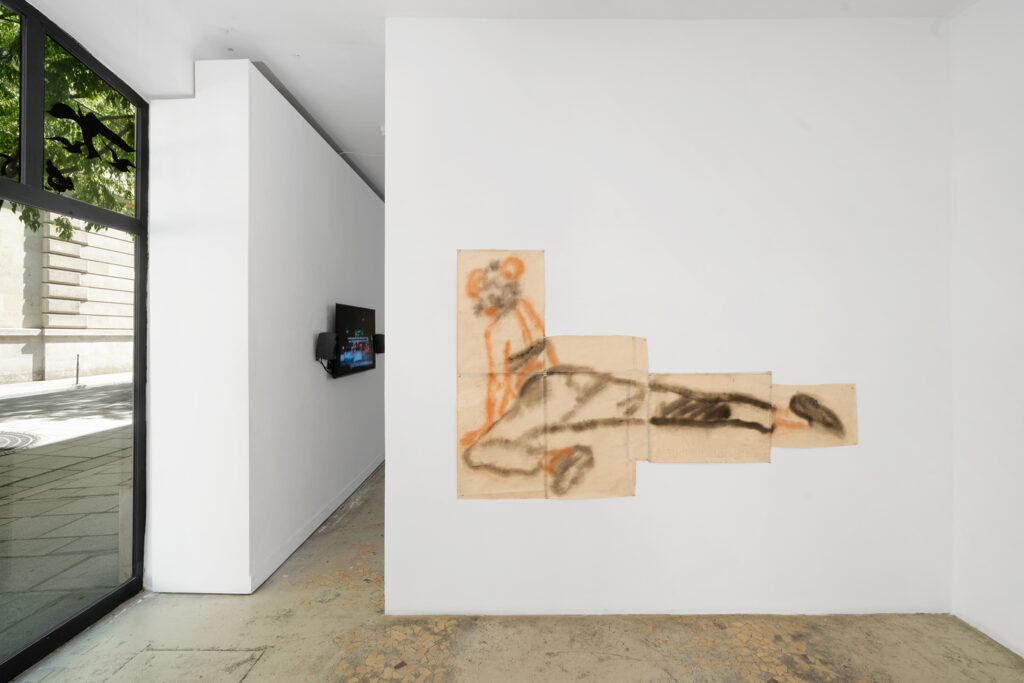
Tiziana La Melia
Cat and Mouse, 2024
sinopia and charcoal on spolvero paper, upholstery tacs
226 x 137 cm
Extract from The Simple Life: Country Mouse City Mouse Hamster.
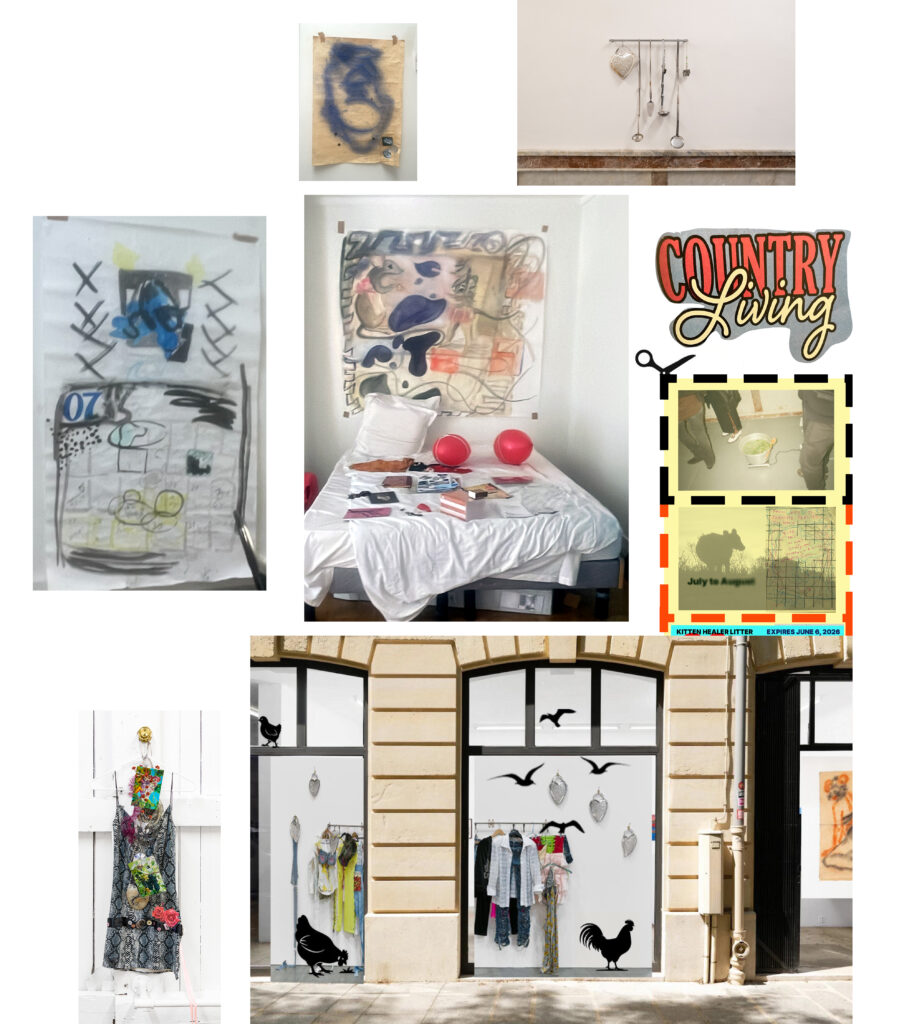
Tiziana La Melia, Kitten Healer Litter exhibition moodboard 2026
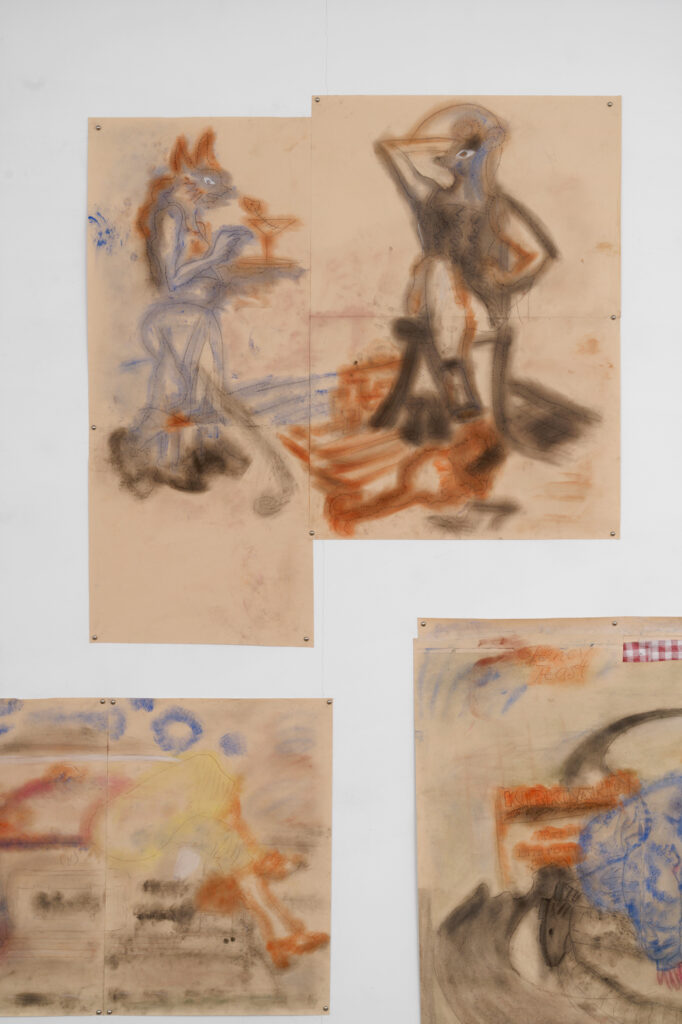
Tiziana La Melia
Cat Waiting On Mouse, 2025
Sinopia, pastel, charcoal, and ink on spolvero paper
123,5 x 118,5 cm
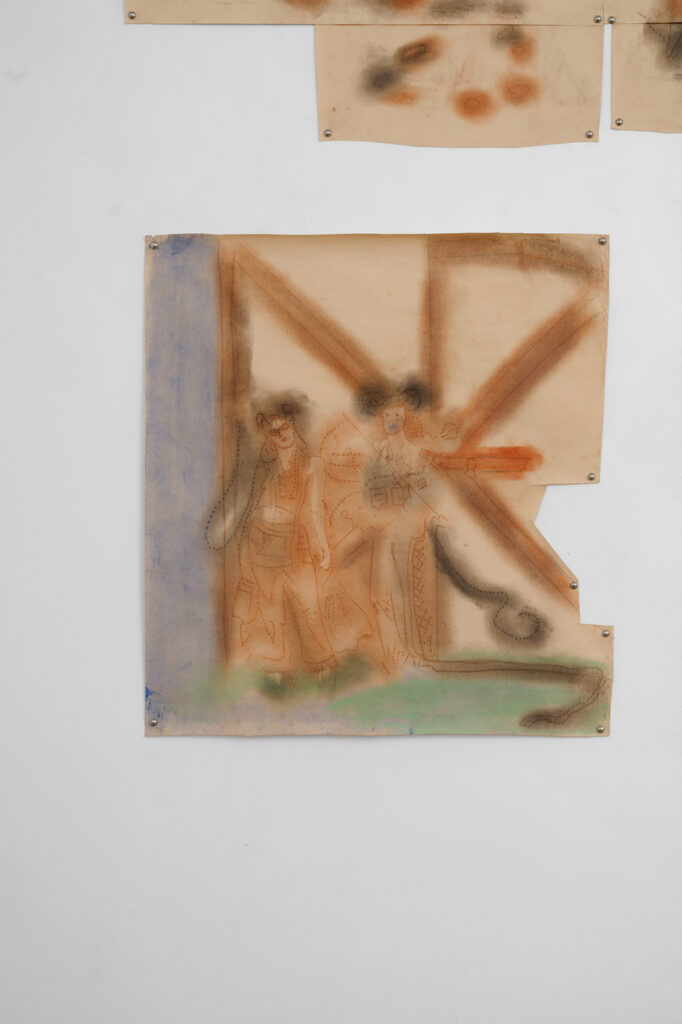
Tiziana La Melia
Exit Apron, 2025
Sinopia, pastel, charcoal, and ink on spolvero paper
73,5 x 69 cm